
Walpole Neighbors by Parcel Source
Start with the physical parcel, not a name list. The state parcel map can display a chosen lot and the lots touching it. It also shows an owner field, land valuation, and land use. Walpole's assessor offers a dated tax snapshot you can pull by address or MBLU. The Registry contributes recorded party and instrument details. The Town Clerk street table gives the number range, ZIP, and precinct for a known address. Each source answers only one narrow question. So a good Walpole neighbor search records what each lookup confirmed and what stays unconfirmed.
| Source | What It Shows About a Block | Access |
|---|---|---|
| Massachusetts Interactive Property Map | Parcel polygons, selected-parcel popup, land valuation or use, and adjacent-parcel tool | Public map with address search, parcel selection, and Find Abutters. |
| Walpole assessor database | Tax-roll owner, situs address, MBLU, and fiscal-year or update context | Public database; a shown owner is not automatically an occupant. |
| Norfolk Registry | Recorded parties, instrument type, date, book or page, plans, and related records | Free index and unofficial image; clean copies have separate terms. |
| Walpole street and precinct table | Street-number range, ZIP, precinct, and split or parity geography | Current PDF; the exact row, not only the street name, is the geographic key. |
| Individual voter form | Match for one named person when the required identity fields fit | Individual state search only; protected voters are not a block-browse result. |
| Walpole historic sources | Dated street-list, directory, newspaper, or map context | Walpole Room and Historical Society holdings; historic roles are not current claims. |
For a current block, the strongest adjacency evidence is parcel geometry. That geometry should be paired with a recorded plan or legal description. A Registry instrument beats an assessor snapshot for ownership. Both belong in your notes, though, with their dates attached. Older blocks call for different tools. The Walpole Room's street lists and city directories can place people in a given edition. But they may name a landmark or village instead of a modern street number. Compare any such result against a map or a later street list before trusting it.
Map a Walpole Neighbor Ring
The MassGIS route is exact and repeatable. Search the address or place, select the target parcel, run Find Abutters, and study the adjacent parcel set. Search results form a parcel set. Beyond that core flow, the map supplies layers, basemaps, a parcel table, measuring and buffer tools, coordinates, print, share, and download controls. Those features describe geography well. Yet they cannot replace the legal description in a recorded instrument or a professional survey when a boundary is in dispute. Note the map access date too, since parcel layers can change. Open the Massachusetts Interactive Property Map to start the abutter process.
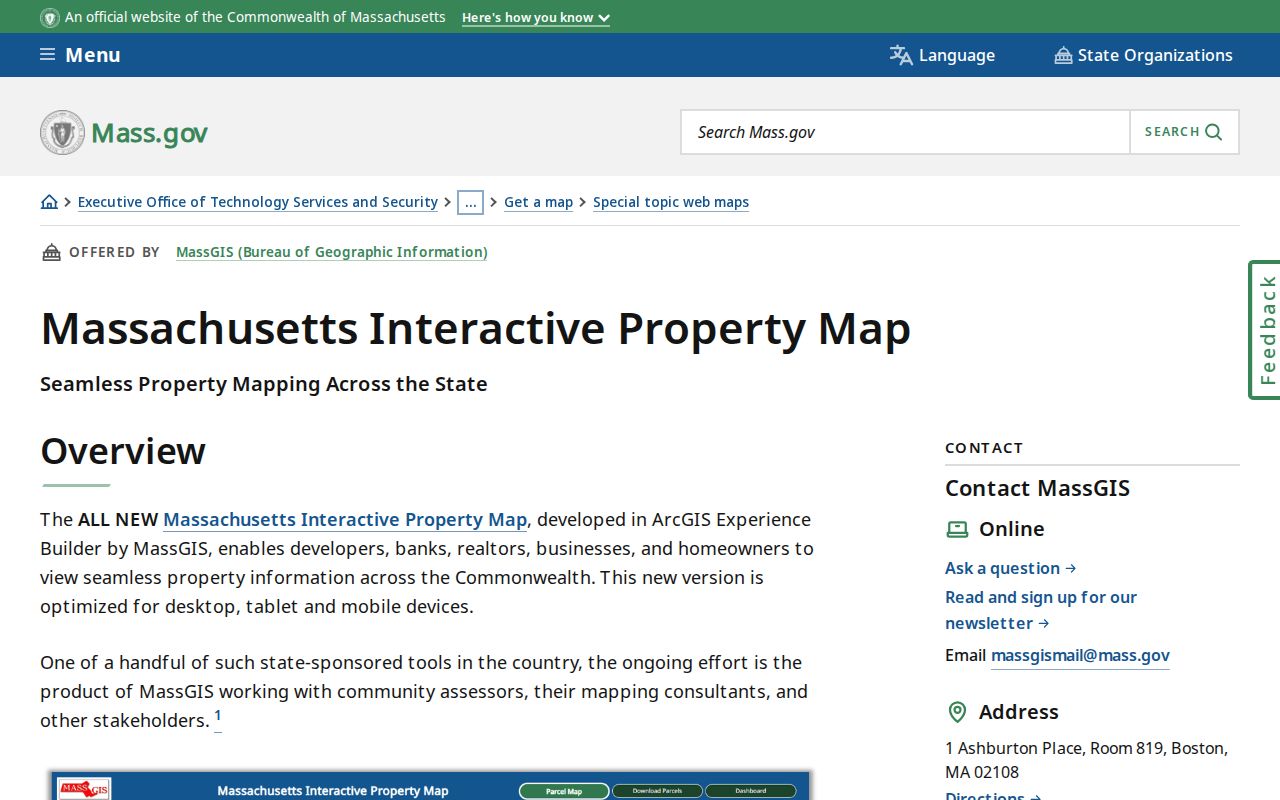
The parcel controls tie one Walpole address to a physical ring of adjacent lots. They do not produce a name-based neighbor list.
For a measured block question, follow this flow: address or place search → select parcel → Find Abutters → adjacent parcel set → Walpole MBLU and assessor snapshot → Registry instrument check. Label each result clearly as geometry, tax-roll ownership, or recorded party information. A neighboring parcel may carry its own legal description. It may also carry an easement, a shared drive, or registered-land status. Closeness on a map alone never identifies a household relationship.
Note: The MassGIS map shows parcels, while deeds and surveys carry the controlling boundary evidence.
Check Walpole Parcels and MBLU
Once the neighbor ring is set, check every parcel on its own. Use Walpole's assessor or tax kiosk for that. Search modes include owner, address, and the three parts of the parcel ID: map, lot, and sub. Walpole calls this identifier an MBLU. Address search accepts a full or partial street phrase. The owner-search guidance suggests starting with a broad surname. Save the situs address and MBLU alongside the fiscal-year context for each parcel. The FY2027 database was last shown updated July 6, 2026. It refreshes two or three times a year. Use the Walpole MassMapper parcel viewer to compare the local geographic display.
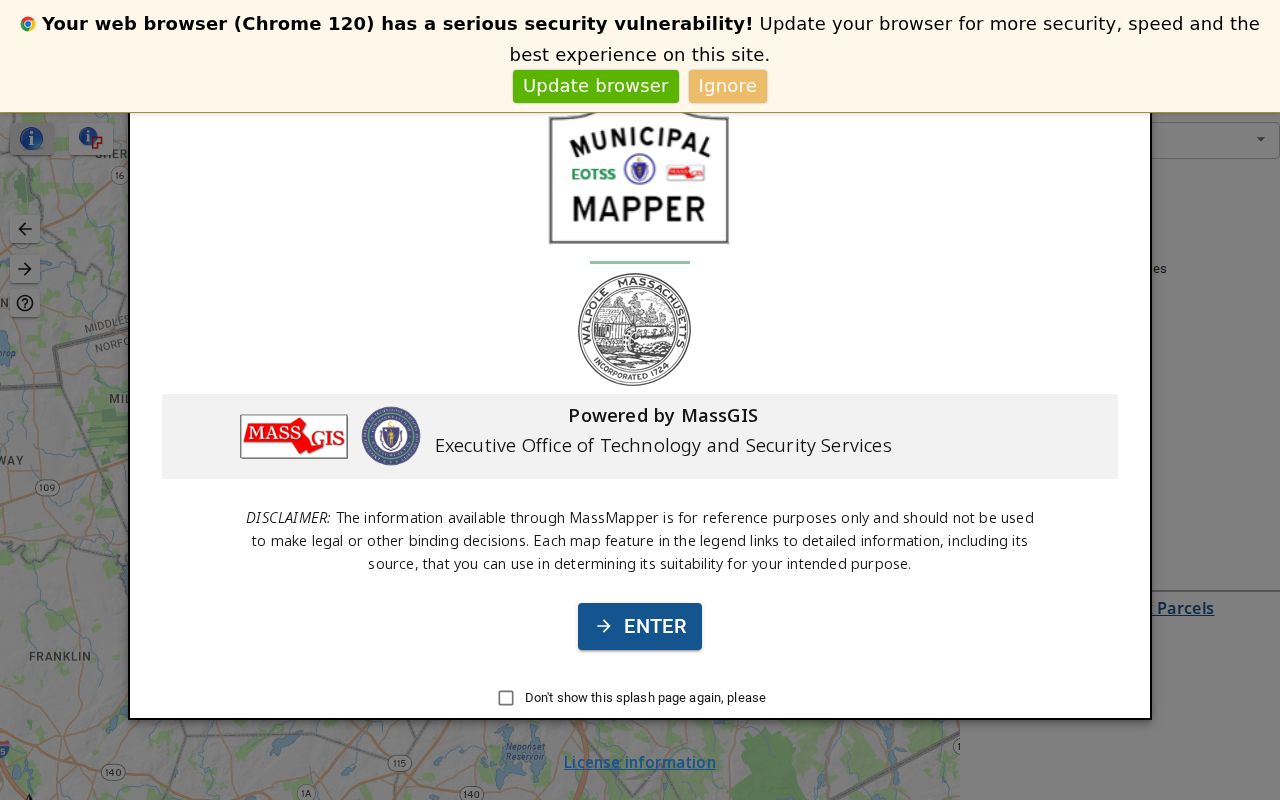
The Walpole parcel view is handy for checking geometry against the assessor's MBLU and the address-based tax record.
- Parcel
- A mapped piece of land used as the geographic unit for the assessor and MassGIS tools.
- MBLU
- Walpole’s map, lot, and sub identifier for a parcel, used to distinguish one property record from another.
- Situs address
- The address used to locate the parcel, which can differ from an owner’s mailing address.
- Abutter
- A parcel that touches the selected parcel in the map tool. It describes adjacency, not friendship or household membership.
Next, verify a current named owner or grantee in the Norfolk Registry. The Registry address search can help for documents from 2003 onward. Older address indexing is very limited. For earlier records, lean on town, party name, legal description, plan, or book and page. Search recorded land and registered Land Court. Do this whenever a chain looks incomplete.
Read Walpole Neighbor Street Ranges
Walpole's street, ZIP, and precinct list has a local quirk worth knowing. One long street can be split by number range, parity, ZIP, and precinct. Preserve the exact street-number row. Do not settle for just the street name. A block may look continuous on a map. But it can cross a precinct line or switch ZIPs farther down the road. Any ZIP-wide claim about Walpole neighbors needs a source. So trace it back to the specific address numbers in the Town Clerk PDF. The Walpole street and precinct crosswalk is the local check. Use it before describing a block's civic geography. The distinction matters most when a voter form asks for a five-digit residential ZIP. A ZIP is delivery geography, not a precinct. It says nothing about who is at an address. For historical blocks, pick a single directory or street-list edition. Use adjacent numbers only when that edition supplies them. Keep landmark wording, like a nearby corner or village, when it does not. Note: Older sources may name a street landmark or village, so it cannot always be safely converted to a modern address.
Follow Walpole Neighbor Voter Rules
Massachusetts keeps voter registration on an individual basis. The state form asks for a first name, last name, and full date of birth. It also requires agreement to its statement. It needs a five-digit residential ZIP Code. A result, or a no-result, covers one person. Nothing about the form works at the block level. Spelling slips, address mismatches, and ZIP errors can block a match. Registration status, timing, or confidential status can do the same. A match does not prove current physical presence. A protected voter may be absent on purpose.
Review the Massachusetts individual voter lookup for its current form requirements.
Local voter and election records sit with election officials. The statewide voter file is controlled, not a general public download. It stays within the applicable public-access rules. M.G.L. c.51 §47C limits central-registry names and addresses to specified recipients under those rules. A lawful local request should describe one particular record. It can otherwise name one chosen year of the Walpole street list. It should not seek a block-wide name list. The library's historic street-list run is likewise limited by year and by its age-17-and-over description.
Find Walpole Neighbor Community Context
Physical adjacency and public community context are two different layers. The Walpole Chamber community-resources listing names clubs and associations around town. Those entries can surface clubs, historical leads, or public events. The Chamber member directory is a business and community directory, though, not a residential roll. Membership never proves someone lives near a chosen parcel. For personal history, the same organizations can still help. They can point a researcher toward public programs, organization records, or the right local contact channel.
Start with the Walpole Chamber community-resources listing.
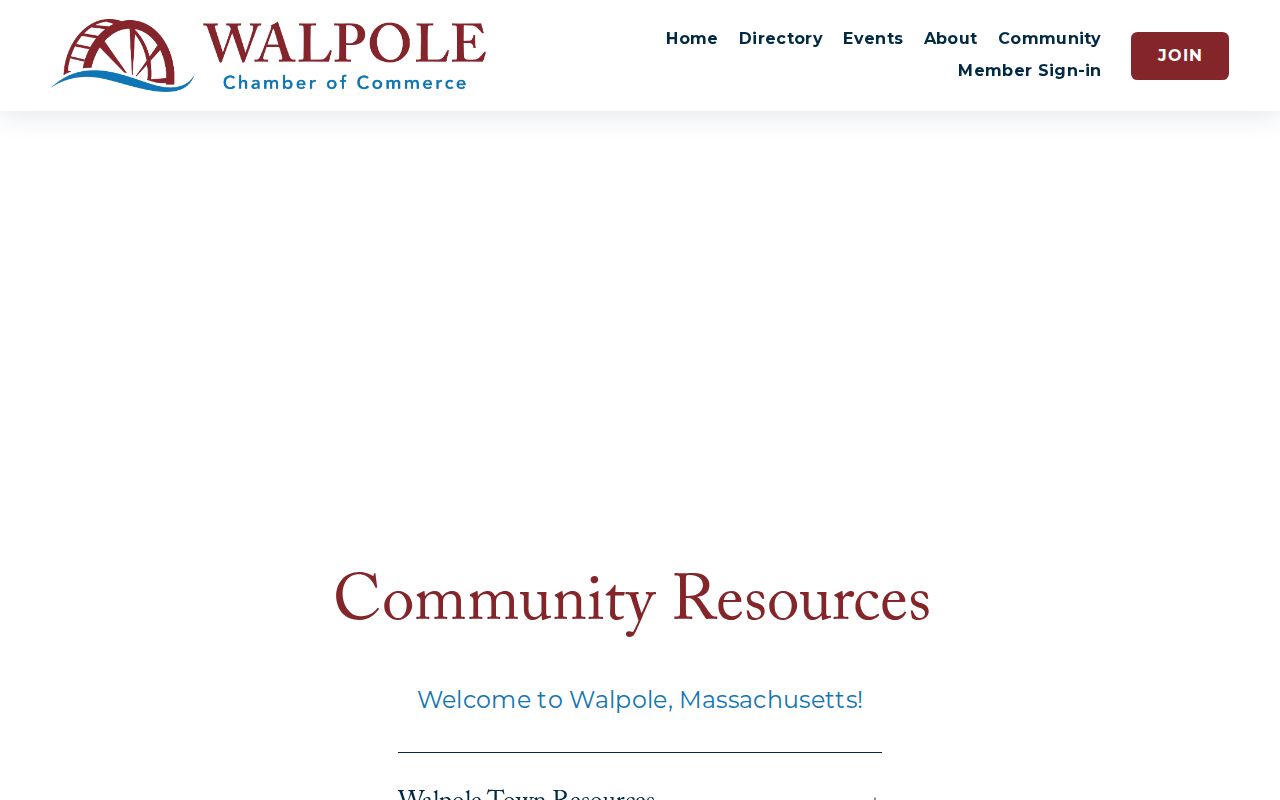
The Chamber resource adds context, never a home-address claim. It describes Walpole organizations without converting club membership into proof of where anyone lives.
| Community listing | Public starting point | Boundary for neighbor research |
|---|---|---|
| Azure Lodge of Freemasonry | Walpole Chamber community resources | Organization context only; membership is not household evidence. |
| German-American Club | Walpole Chamber community resources | Use public organization information, not inferred addresses. |
| Italian American Club of Walpole | Walpole Chamber community resources | A listed group does not establish a member’s parcel connection. |
| Junior Woman’s Club and Knights of Columbus | Walpole Chamber community resources | Use public contact channels only; do not assume a member roster is public. |
| VFW, Lions Club, and Walpole Sportsman’s Association | Walpole Chamber community resources | These are community leads, not a list of nearby residents. |
Compare Walpole Neighbor Sources
Official sources keep a custodian, a date, and a defined record role. Commercial neighbor tools blend public filings, stale data, and inferred links with no such trail. The real comparison is not name count. It is whether a claimed connection traces back to an assessor snapshot, a recorded instrument, a dated directory, or a lawful verification result. Keep only what the question needs. Preserve the source date with everything you keep.
| Source category | Strength | Limit |
|---|---|---|
| Official parcel, assessor, and Registry records | Named custodian, parcel or instrument placement, and a record date | Different records describe geometry, tax ownership, or recorded parties, not one current household list. |
| Historic Walpole Room materials | Dated directory, street-list, map, newspaper, or census context | Historic spelling, landmarks, and edition dates need corroboration before a modern claim. |
| Commercial neighbor tools | May offer a starting lead | Can combine stale records and inferred associations; check every useful item with a custodian. |
For a full address-by-address record chain along a named road, use the Walpole street records page. The narrower neighbor method sticks to adjoining parcels.
Protect Walpole Neighbors and Privacy
Walpole neighbor research must leave protected information protected. Participants in the Massachusetts Address Confidentiality Program use a substitute address for public-facing transactions. Their actual address stays confidential. Confidential voter information carries special protection as well. Never rebuild a protected address from public records. Impounded court material, sensitive vital-record fields, and personal identifiers are not gaps to fill, whether reached through parcel, deed, directory, court, or community sources. An absent result may be absent for good reason.
The Massachusetts Address Confidentiality Program page explains the protected-address route. A safety-sensitive question belongs with an official authority or the applicable confidentiality channel, not more cross-searching. If a public record needs correction, ask the office that holds it. A request under Massachusetts Public Records Law, M.G.L. c.66, must seek an existing defined record and never overrides these protections.
Note: Name similarity, a shared ZIP, a community listing, or a nearby parcel is only a lead, never proof of a current neighbor relationship.